
Growing by LEAPS within Bounds
Why small OTM bets are the way I choose to buy convexity.

Income keeps you solvent. Convexity makes you rich.
You’re mastering the Wheel—selling premium month after month or week after week, lowering cost bases, collecting time decay like rent. Your portfolio grinds upward with the reliability of a Toyota Corolla. But what about that Lotus? It still calls to us no matter how responsible we might be.

The wheel is great at smoothing portfolio volatility with income, but what happens when you’re right about a major trend? What if you correctly identify the next bull market in energy1, the remonetization of gold, or China’s reemergence —but your strategy caps your upside at 1-3% monthly premium?
You need convexity. But you also need to avoid blowing up your account chasing it.
Enter LEAPS: Long-term Equity Anticipation Securities. These are simply options with 9+ months until expiration, but their strategic role is more profound than they sound. For me, LEAPS have transformed the Wheel from a cash-flow grinder into a barbell strategy: steady premium income on one side, asymmetric upside on the other.
So how do we do it? How can we grow by LEAPS—with strictly defined bounds.
Disclaimer: This is educational content, not investment advice. Options involve risk; losses can exceed premiums paid when using spreads or complex strategies.
The Problem with Unlimited Conviction
Most traders lose money in one of two ways:
Path 1: The Premium Seller’s Ceiling You run a perfect Wheel for three years. Every month, like clockwork, you collect 1.5-2.5% returns. Compounding works beautifully—until a macro shift happens. Gold doubles. Your uranium thesis plays out. Chinese tech rips 150%. You made your premium, but you capped all your gains at strikes that got called away early.
You were right. You just didn’t have the position structure to capitalize. Trust me when I say, that hurts. A bull market kicks everyone off their back, even those on the Wheel Strategy.
See below for a concrete example:
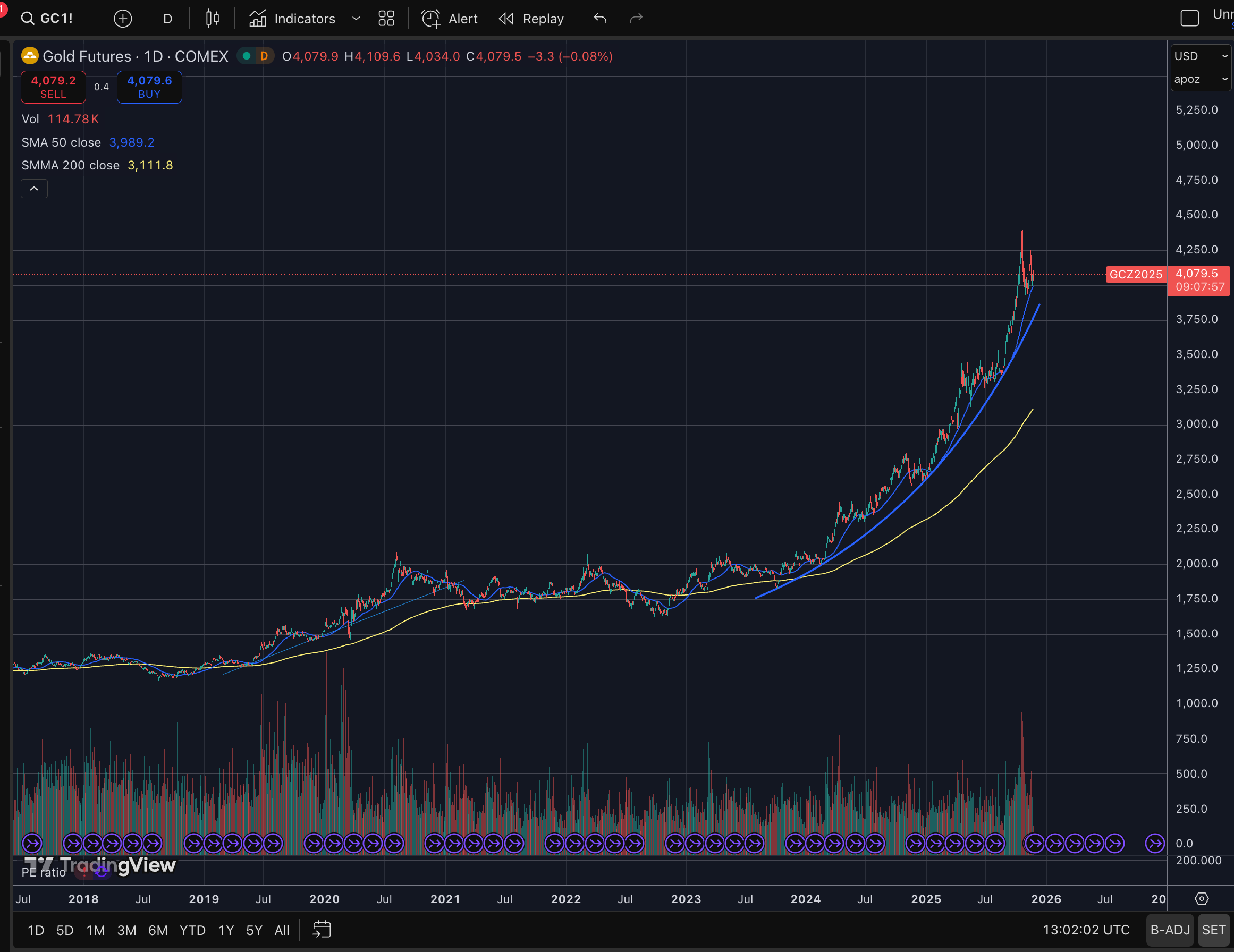
Path 2: The Directional Trader’s Crater You’re convinced about a trend, so you lever up: concentrated stock positions, margin, maybe weekly calls for “efficiency.” The thesis is sound. The timing isn’t. A 30% drawdown wipes you out before the trend even starts. Or worse—you’re right on direction but wrong on timing, and time decay or volatility crush kills you anyway.
You were right. You just didn’t have the risk management to survive. Again, look at the gold chart above. While it was happening, a drop from $2100 to $1600 in less than a year can really test one’s resolve.
The barbell solves both problems.
The Barbell Structure: Antifragility in Practice
Think of your portfolio in two distinct sleeves:

Sleeve 1: The Base (90-95% of capital)
Running the Wheel on quality names
Cash-secured puts and covered calls
Collecting premium, lowering cost bases
The Corolla: steady, predictable, income-generating
Maximum risk: assignment and holding through drawdown (which you’re fine with because you chose quality)

Sleeve 2: The Convexity Layer (5-10% of capital)
Long-dated calls (LEAPS) on high-conviction themes
Defined risk: you can only lose what you pay
Asymmetric payoff: potential 2x, 5x, 10x+ returns
The Lotus: exciting, explosive, but with strict capital bounds
The beauty? The base funds the convexity layer. Your wheel premium becomes the capital you allocate to LEAPS. If every LEAP goes to zero, your base strategy keeps grinding. But when you’re right, the LEAPS can multiply your portfolio several times over.
This is Nassim Taleb’s barbell strategy applied to options: maximum safety plus maximum opportunity, with nothing in the middle.
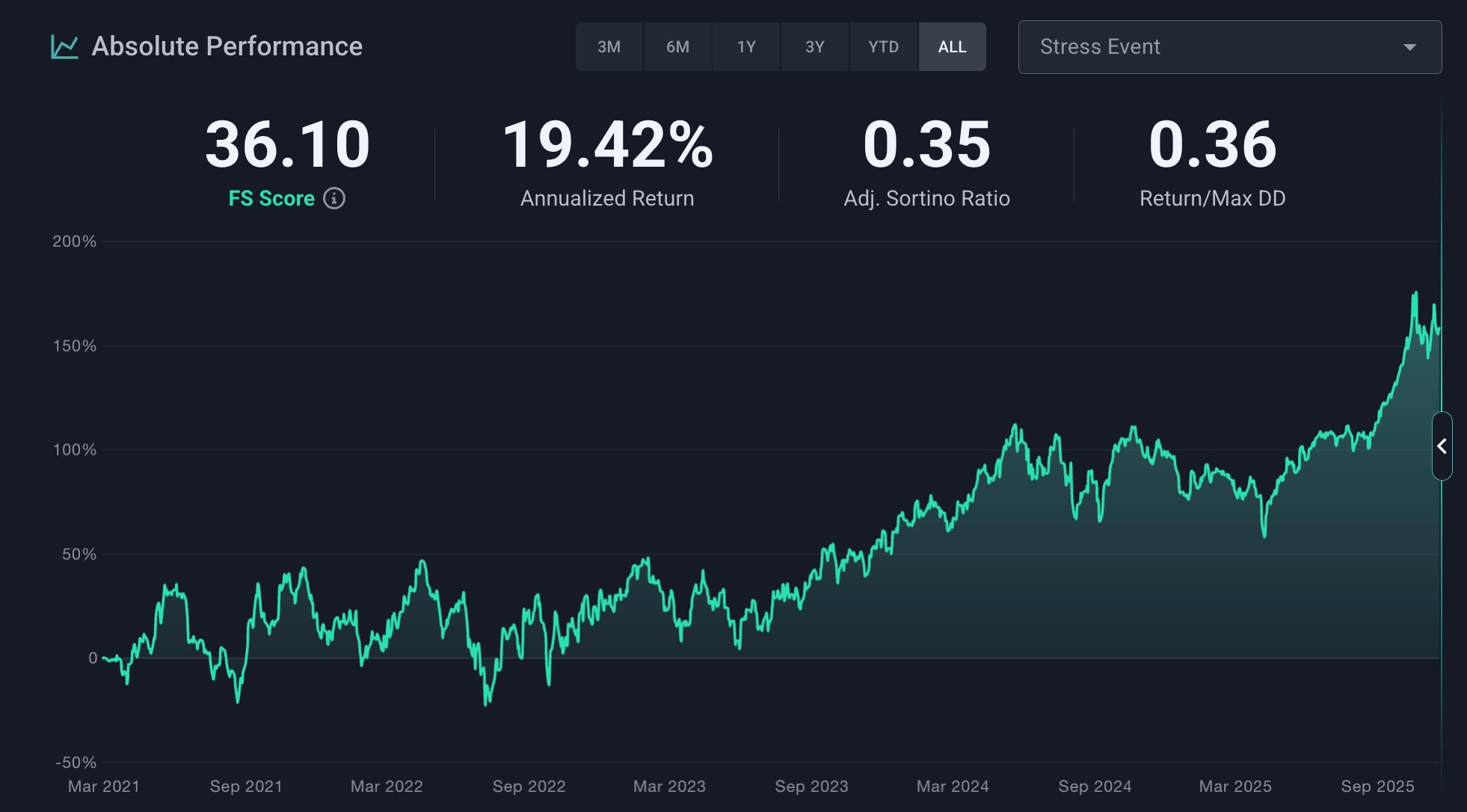
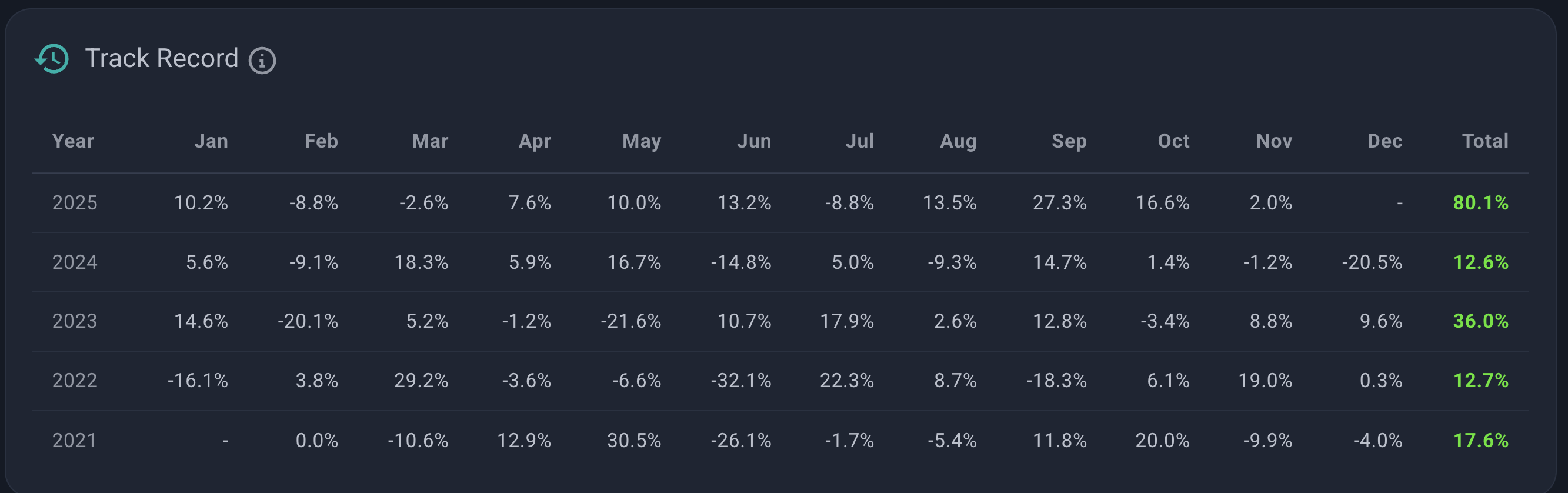
See above for some data on a portfolio that implemented LEAPS with the wheel beginning in June 2023. Drawdowns were reduced (Income is a good pillow), and LEAPS allowed for large portfolio value increases.
Why LEAPS Specifically?
Good question. I mean, why not just buy shares in your high-conviction ideas? Why use options at all?
Because LEAPS give you leverage without the margin risk.
Consider two scenarios:
You’re bullish on Uranium mining. You have $10,000 to deploy.
Option A: Buy shares
$10,000 buys ~140 shares of CCJ at $70
If CCJ doubles to $140, you make $10,000 (100% return)
If you’re wrong and CCJ drops 50% to $35, you lose $5,000 (50% loss)
Option B: Buy LEAPS
$10,000 buys ~25 contracts of CCJ $80 calls expiring in 18 months at $4.00 per contract ($400 per contract × 25 contracts = $10,000)
If CCJ doubles to $140, your calls are worth at least $60 each = $150,000 (1,400% return)
If you’re wrong and CCJ drops or stays flat, your maximum loss is still $10,000 (100% loss of that position)
Notice the asymmetry: with shares, you risk 50% to make 100%. With LEAPS, you risk 100% of a defined amount to make 500%+ returns. The second structure has convexity—and crucially, your maximum loss is capped at exactly what you chose to allocate.
The key insight: LEAPS can only hurt you as much as you let them. Shares plus margin can wipe you out.

How to Select LEAPS: The 4-Filter System
Not all LEAPS are created equal. Here’s my framework for choosing positions that balance conviction with survivability:
Filter 1: High-Conviction Macro Themes

Only buy LEAPS on trends you’d bet your reputation on. This isn’t for hunches. Examples:
Gold remonetization amid dedollarization (GDX, GDXJ, GLD, SILJ)
Uranium supply deficit meeting AI data center demand (URA, CCJ, URNM, U.UN)
Chinese equities mean reversion after multi-year compression (KWEB, FXI, 9998.HK, 3067.HK)
Bitcoin as digital gold in sovereign debt crisis (BTC, IBIT)
If you can’t write a three-paragraph bear case and still believe in the bull case, don’t use LEAPS.
Filter 2: Time Horizon (12-24 months minimum)
The further out, the more time you buy for your thesis to play out. My preference:
Sweet spot: 18-24 months
Survives multiple volatility cycles
Less daily theta bleeding than shorter options
Still has enough liquidity for exits
Captures full cycle moves (not just momentum bursts)
Avoid 6-9 month LEAPS unless you have edge on timing. Remember: you’re using these for structural trends, not quarterly earnings.

Filter 3: Strike Selection (20-40% OTM)
This is where discipline matters.
OTM (50%+): Cheap, lottery ticket behavior. Low probability, usually expires worthless even if you’re directionally right but magnitude is off. Only go this far out if you have an extreme edge.
ATM or ITM: Expensive, high Delta, behaves too much like shares. You lose the leverage benefit and pay excessive premium.
The Comfort Zone: 20-40% OTM
Meaningful discount to stock purchase
Requires conviction (not speculation)
Still participates strongly if the trend confirms
Reasonable implied probability of profit
Example: GDX trading at $70
Very aggressive: $100 strike (43% OTM)
Strong conviction: $85-95 strikes (21-36% OTM)
Too conservative: $70 strike (ATM) acts like expensive shares
Filter 4: Capital Allocation (Never more than 1.5% per position)
This is the risk management that keeps you alive.

Individual position sizing:
Maximum 5-10% of total portfolio in LEAPS positions
Prefer 1% for most positions, higher % only for highest conviction
Absolute maximum of 10% total portfolio in all LEAPS combined (entry cost basis)
Example portfolio: $100,000 total
$95,000 in Wheel strategy (base layer)
$5,000 in LEAPS (convexity layer)
$1,000 in GDX calls (gold thesis)
$1,000 in URNJ calls (uranium thesis)
$1,000 in BABA calls (China thesis)
$1,000 in IBIT/Bitcoin calls (digital gold thesis)
$1,000 in cash reserve or opportunistic position
If all five LEAPS go to zero, you lose $5,000 (5% portfolio drawdown). Painful, but survivable—your Wheel base kept compounding the entire time. But if even two of those 5x while others expire worthless, you’ve turbocharged your portfolio.
Filter 5: Implied Volatility (IV) As A Gatekeeper
IV is the price of uncertainty. Pay too much, and your LEAPS fight a headwind from day one; pay too little, and you may be buying a stagnant thesis. Treat IV as a gatekeeper, not a guess.
Principles:
Price the thesis, not the excitement: Elevated IV means you’re paying for headline risk and recent moves. If the story is already “hot,” wait for IV to cool.
Duration dampens noise: Longer-dated options reduce daily theta and Vega shocks, but they don’t eliminate overpaying. A bad entry on IV is still a tax.
IV must match the regime: Structural themes can tolerate mid-range IV; short-lived momentum can’t.
Operational Guardrails:
Prefer mid-range IV: Deploy when IV sits near its 6–12 month median. Avoid the top quartile unless you have a timing edge or pair with premium-selling overlays.
Stage entries around catalysts: Build partial positions pre-catalyst, add on post-event IV crush if thesis remains intact.
Liquidity first: Choose underlyings with tight spreads and active LEAPS chains. Wide spreads multiply the IV tax.
Tactics To Improve IV Entry:
Deploy on pullbacks: Enter after a volatility spike subsides or on mean-reversion days when IV normalizes.
Ladder in: Split entries (e.g., 40/30/30) across weeks to average IV and avoid single-print overpayment.
Think about alternative vehicles. For example, gold mining ETFs have higher implied volatility compared with the underlying metals (GDX vs GLD), so when buying LEAPS for an outsized move, GLD would be way more attractive. GDX on the other hand would be way better for The Wheel.
Example:
Uranium ETF (URA) spikes 18% on news; IV Rank jumps to 75. Rather than buying full-size LEAPS at peak IV:
Take a starter 0.3% position
Wait for consolidation and IV Rank to fall toward 40–50
Complete the allocation, or use a short call overlay to offset rich premiums
Bottom Line: IV is the toll booth. Pay it wisely. Enter when enthusiasm is priced fairly, size down when IV is stretched, and use duration plus overlays to keep convexity without donating to the volatility gods.

Reminder on antifragility: limited downside, unlimited upside, and you stay in the game. Consistent Convexity is the goal.
Portfolio Math: How the Barbell Compounds
Let’s walk through a realistic two-year scenario to see how this works:
Starting capital: $100,000
$95,000 in Wheel strategy
$5,000 in LEAPS (5 positions at $1,000 each)
Year 1:
Wheel performance:
Monthly premium: 2% average
Annual return: ~26% (compounded, accounting for some assignments)
Ending value: $119,700
LEAPS performance (scaled to $1,000 tranches):
Position 1 (GDX): +200% → $3,000
Position 2 (CCJ): +50% → $1,500
Position 3 (BABA): -80% → $200
Position 4 (GBTC): +300% → $4,000
Position 5 (Opportunistic): -60% → $400
LEAPS total: $9,100 (from $5,000)
End of Year 1: $128,800 (+28.8% total portfolio)
Year 2 strategy:
Roll Wheel base to $119,700 (the larger base now compounds)
Take $4,000 from LEAPS gains → reallocate to 4 new LEAPS positions ($1,000 each)
Let remaining $5,100 in winning LEAPS run with trailing stops
Illustrative outcomes in Year 2:
New LEAPS basket: two double (+100% → $4,000), one -60% ($400), one expires worthless ($0) → $8,400 total
Running LEAPS (house money): blended +50% across the basket → $7,650
Wheel performance Year 2 (on $119,700):
~26% compounded → $150,822
End of Year 2:
Wheel: $150,822
LEAPS: $8,400 + $7,650 = $16,050
Total: $166,872 (from $100,000)
That’s the barbell in practice: the base keeps grinding, LEAPS take bounded shots, wins fund new shots, and the portfolio compounds even when several LEAPS go to zero.
Common Mistakes when LEAPing (And How to Avoid Them)

Mistake 1: Over-allocating to LEAPS “I’m so convinced about uranium, I’m putting 50% of my portfolio in CCJ calls.”
You might be right about uranium and still lose everything to timing, volatility crush, or general market selloff. Keep strict position limits. Conviction is not the same as sizing.
Mistake 2: Buying Too Short-Dated “These 6-month calls are cheaper than the 18-month ones.”
They’re cheaper because they’ll probably expire worthless. Sounds obvious but greed has a seductive way with us. Remember: you need time for structural trends to overcome noise. Pay up for runway—it’s the only way to survive being early.
Mistake 3: Chasing Momentum with LEAPS “This stock is up 40% this month, time to buy calls!”
LEAPS are for trends you identify early, not momentum you’re chasing. If IV is already elevated because the move happened, you’re paying peak premium. Better to wait for consolidation or deploy into weakness. OTM CSPs might be a better bet.
Mistake 4: Treating LEAPS Like Lottery Tickets “I’ll just buy a bunch of far OTM calls and see what hits.”
This isn’t a casino. Every LEAPS position should map to a thesis you’ve researched and would defend. Spray-and-pray destroys capital. Concentrated conviction with position limits builds wealth.
Mistake 5: Not Taking Profits “My LEAPS are up 300%, I’ll just let them ride.”
Options can go to zero. When you’ve made 2-3x on a position, consider taking half off or rolling it further out if your thesis is still in play. Let winners run, but lock gains when volatility gives you outsized returns early. The goal is portfolio growth, not bragging rights.
Real Example: The Gold LEAPS Trade
Here’s how the gold thesis looks with tighter sizing, IV discipline, and clear exits.

Setup (January 2023):
Thesis: Gold remonetization amid dedollarization2, BRICS expansion, persistent central bank buying
Underlyings considered: GLD (lower IV, tighter spreads) vs GDX (higher IV, higher beta)
IV filter: GLD favored for LEAPS due to lower IV and deeper liquidity; GDX better for running the Wheel
Entry: GLD trading at ~$170
LEAPS: Bought January 2025 $200 calls at ~$6.00 (IV near its 12-month median)
Position size: $1,000 (1% of $100k portfolio) → ~1 contract + starter
Max loss: $1,000 (defined)
Scenario A: You’re wrong (GLD stalls or drifts lower)
Calls decay toward $0 into late 2024
Loss capped at $1,000
Wheel base keeps compounding; portfolio impact limited to -1%
Scenario B: You’re right (GLD trends to ~$200–210 by mid-2024)
Calls worth ~$10–13 intrinsic + time value
Position value: ~$1,700–$2,200 (70–120% gain)
Action:
Take 50% off near 100% gain (lock ~$500–$600 profit)
Let remainder run with 30–40% trailing stop on option value
Optional roll: out-and-up to Jan 2026 $210–220s on strength to extend runway
Higher beta alternative (for illustration): GDX
Entry: GDX ~$32, Jan 2025 $40 calls ~$2.50 (higher IV)
Position size: $1,000 (1% of portfolio) → 4 contracts
If GDX reaches $45–50 by mid-2024, calls trade ~$5–10
Actions mirror GLD: trim half near 2x, trail remainder; consider poor man’s covered call overlay during IV spikes
Catalyst & IV management:
Avoid peak IV entries after headline spikes; stage entries (e.g., 40/30/30) over weeks
Add on post-event IV crush if thesis intact
Favor GLD for LEAPS when IV in GDX is stretched; use GDX for Wheel premium generation
Takeaways:
Vehicle matters: GLD for convexity at reasonable IV; GDX for income via the Wheel
Sizing saves you: 1% tranches keep you antifragile
Process over prediction: trim, trail, or roll when the trend confirms; cut if thesis breaks
Integration: How LEAPS and the Wheel Work Together

The magic happens when you connect both sides of the barbell:
Strategy 1: Premium Funds Conviction
Each month, allocate 20-30% of Wheel premium to LEAPS
$2,000 monthly premium → $400-600 toward new LEAPS
Over 12 months, you’ve built $5,000-7,000 in convexity positions
Your base strategy literally funds your asymmetric bets
Strategy 2: LEAPS Profits Expand the Base
When a LEAPS position doubles or triples, take profits
Reallocate 50-70% back to Wheel strategy (larger base = more premium)
Use 30-50% for new LEAPS positions
Virtuous cycle: bigger base → more income → more LEAPS → bigger wins → bigger base
Strategy 3: Hedge with Correlation
If running the Wheel on miners (GDX, GOLD), buy LEAPS on gold (GLD) or related commodities
Your base collects premium, your LEAPS capture sector momentum
Both profit from the same thesis at different risk/return profiles
Strategy 4: Tactical Adjustments
When IV spikes on your LEAPS (earnings, macro event), consider selling calls against them (poor man’s covered call)
Collect premium on volatility while maintaining long exposure
Requires active management but can smooth returns
Position Management: When to Exit
LEAPS aren’t set-and-forget. Here are my rules:
Take 50% off or Roll and add 12 more months at 100-150% gain Lock profits when they appear. Options can evaporate quickly. Half off or rolled protects capital while leaving upside open.
Full exit to cash or longer dated LEAP at 200%+ if less than 6 months remain
Time decay accelerates. Don’t get greedy when theta is screaming.
Cut losers at -50% if thesis breaks If fundamentals change (not just price action), admit you’re wrong. Redeploy to better opportunities.
Roll out and up if winning early Position up 100% but still 12+ months left? Consider rolling to higher strike further dated to capture more upside with less capital at risk.

The goal is not to maximize every trade. It’s to protect capital and harvest enough asymmetric wins to transform portfolio compounding.
Advanced: Funding LEAPS with CSP Premium
Here’s the purest expression of the barbell strategy:
Week 1-4: Run cash-secured puts on quality underlyings
Collect $2,000 in premium
End of Month: Allocate to LEAPS
$500 to GLD calls (gold thesis)
$500 to URNM calls (uranium thesis)
$500 to BABA calls (China thesis)
$500 reserve for opportunistic entries
Result: Your Wheel strategy has zero downside (CSPs on stocks you’d own anyway) and now funds your convexity layer. Even if your LEAPS go to zero, the premium came from time decay you collected anyway. It’s genuinely house money.
Over 12 months, that’s $6,000 deployed into asymmetric positions that cost you nothing from your principal. This is an example of how you grow portfolio value without increasing risk.

The Psychology: Why Most Traders Fail at This
The barbell requires emotional discipline most traders don’t have:
Tolerance for small losses: You need to watch LEAPS positions drop 50-100% without panic-selling. If you sized correctly, this is just part of the process.
Patience for Wheel grinding: Premium selling isn’t exciting. You need to embrace 2% monthly returns coupled with drawdowns. All while your friends brag about 50% weekly gains (before they blow up).
Taking profits early: When LEAPS go up 200%, you’ll be tempted to “let it ride.” You need to lock gains even when it feels like you’re leaving money on the table.
Rebalancing discipline: When LEAPS outperform, you need to reallocate to the base instead of chasing more convexity. The boring decision is usually the right one.
The traders who succeed with this strategy are the ones who treat it like a business: mechanical execution, disciplined position sizing, unemotional rebalancing. The ones who fail are chasing excitement or trying to predict timing.
Your edge isn’t prediction. It’s structure. It is process. Sowing those seeds in fertile ground and letting time do its thing.
Conclusion: Bounded Bets on Unbounded Outcomes
The Wheel gives you consistency. LEAPS give you growth. Together, they create a portfolio structure that’s antifragile: robust to volatility, positioned for asymmetry, and systematically exploiting both theta decay and convexity.
You’re not trying to predict the market. You’re not levering up on conviction. You’re simply:
Running a profitable base strategy that generates cashflow with buy and hold assets
Taking small, defined bets on high-conviction trends
Sizing so no single position can hurt you
Capturing asymmetric upside when you’re right
Surviving comfortably when you’re wrong
This is how you grow by LEAPS—with strictly defined bounds.
Your next steps:
Audit your portfolio: do you have income stability or just directional bets?
Identify 3-5 macro themes you’d defend for 18-24 months
Build your base with the Wheel (or strengthen existing positions)
Allocate 2-5% into your first LEAPS position on your highest conviction theme
Set calendar reminders to review positions quarterly, not daily

And remember: the Corolla gets you there. LEAP into that Lotus when your convictions have played out over time.
Want to pressure-test your LEAPS strategy before deploying real capital? Subscribe to my course for scenario-based quizzes and access to the LEAPS sizing calculator. The goal isn’t more knowledge—it’s better execution under uncertainty.

